
‘Why Shakespeare Still Speaks to Us’
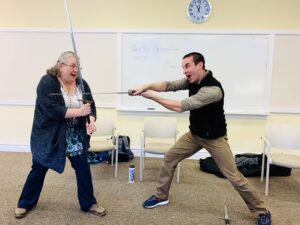
More than four centuries after his death, William Shakespeare continues to shape how we understand love and loss, power and jealousy, identity and imagination. Encore Learning’s Shakespeare-focused courses invites participants to rediscover his work not as distant literary monument, but as living theater—meant to be read, discussed, and experienced on the stage.
The four courses approach Shakespeare from multiple angles, blending close reading, historical context, performance analysis, and modern reinterpretation. Together, they offer participants a deeper appreciation of how Shakespeare’s plays continue to resonate in contemporary culture.
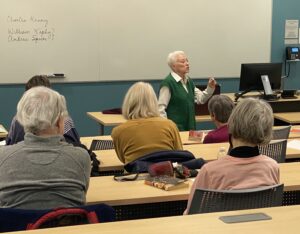
The series begins with Theater Appreciation, led by instructor D. Ohlandt, designed for anyone who enjoys attending live theater and wants to enhance that experience. Participants read and discuss selected works before seeing three major productions in the Washington, D.C. area—As You Like It at the Folger Theatre, Appropriate at Olney Theatre Center, and Hamnet at the Shakespeare Theatre Company. After attending the performances independently, the class reconvenes to explore what unfolded on stage, examining acting choices, directorial vision, and production values under the guidance of an instructor trained in theater history and dramatic theory.
Hamlet’s Children with Iska Alter explores how Shakespeare’s most celebrated tragedy has provoked imaginative responses across centuries. Through readings of Maggie O’Farrell’s Hamnet, John Updike’s Gertrude and Claudius, and Tom Stoppard’s Rosencrantz and Guildenstern Are Dead, participants consider what happens when untold stories and imagined backstories are brought to the center.
In The Tempest: Shakespeare’s Final Masterpiece, led by Tom Manteuffel, participants turn to what many consider Shakespeare’s most reflective and luminous work. Written near the end of his career, the play blends magical realism, comedy, and meditation on power, forgiveness, and aging. Close attention is paid to Shakespeare’s language and its ability to create both fantastical worlds and emotional depth.
The series concludes with Michael Collin’s course, Tragedy of Othello, a searching examination of one of Shakespeare’s most challenging plays. Through guided reading and discussion, participants explore themes of racism, misogyny, jealousy, and trust, culminating alongside a new production at the Shakespeare Theatre Company.
Taken together, these courses invite participants to encounter Shakespeare as both playwright and cultural force—one whose works continue to provoke debate, inspire new art, and illuminate enduring questions about human nature.